ICE in Minnesota
It was mid-morning on Wednesday, January 7, 2026. Breck students of all grade levels boarded yellow school buses to head to their first Community Partnership day of the new year.
The U.S. Department of Homeland Security’s “Operation Metro Surge” – an ongoing deployment of thousands of armed and masked agents from the United States Immigration and Customs Enforcement (ICE) – had been underway for over a month. On the morning of the 7th, about 2,000 ICE agents had already been deployed to Minneapolis and St. Paul, with the stated purpose of detaining and deporting undocumented immigrants.
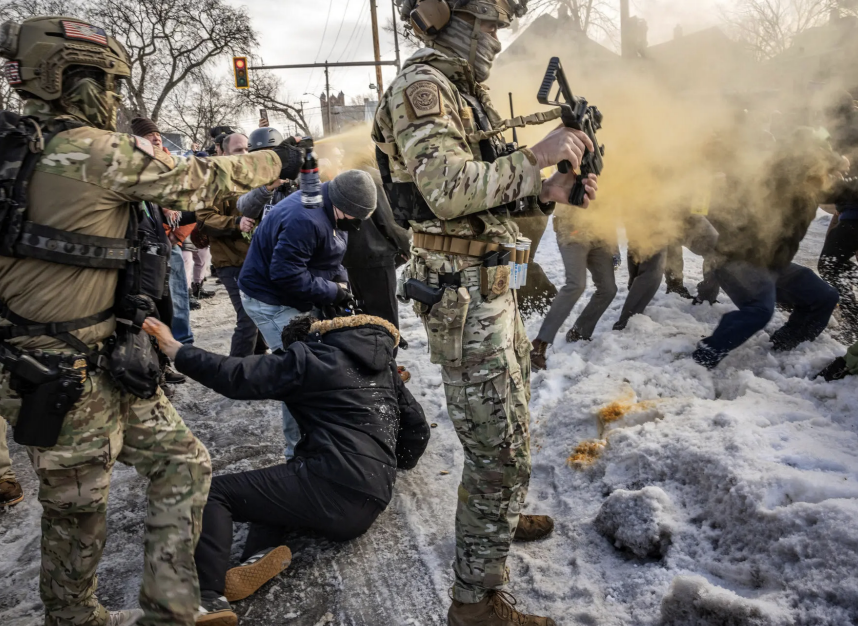
But for some members of the Breck community, the ICE presence in our city remained largely “abstract” until that Wednesday morning at around 9:30AM, the moment when an armed ICE agent shot and killed 37-year-old U.S. citizen Renee Nicole Good through the window of her car on Portland Avenue near East 34th St. At the time of the shooting, students from two Breck Community Partnerships – Loaves and Fishes and Pillsbury House – were in close proximity to the violence. Both student groups were forced to go into a lockdown at their Community Partnership locations and – while being escorted back to school by Breck security – drove directly through the aftermath of the shooting on Portland Avenue. Gabby Stratton ‘26, a member of the Loaves and Fishes Community Partnership, described the situation as “incredibly disorienting.” She added, “we didn’t fully understand what was happening yet. The brutality was disgusting, we watched people get gassed and thrown. It was the most insane experience I’ve had in my life.”
Good’s death marked a turning point. Rather than simply learning about the event after the fact, Breck students were physically close to it, caught in its immediate aftermath. While ICE has reportedly shot at people at least 16 times in 2025, Good’s killing – caught on video from many angles and resulting in the death of a white U.S. citizen – quickly and unprecedentedly became a top headline in national political discourse. Reactions, both at Breck and nationally, split sharply along partisan lines, with President Donald Trump publicly defending the killing as an act of self-defense and labeling Good a domestic terrorist. Within Breck’s own classrooms, teachers – particularly those in the History Department – scrambled to contextualize the rapidly unfolding events.
On Wednesday, January 14 – a week after the shooting – history faculty hosted a lunchtime discussion to address the historical background and constitutional questions surrounding ICE. The goal of the session was to help students deepen their understanding of the larger context and scope of these current events. Each history teacher explained one section of the larger topic: Mr. Daniel presented about the historical context of immigration law; Ms. Adey overviewed the constitutional issues at play; HP described federalism as it relates to Operation Metro Surge, and so on. During the session, APUSH and AHR teacher Dr. Keljik delivered his segment about why Minnesota specifically has been a recent target of ICE. He cited Minnesota’s history of liberalism and liberal resistance, the state government’s historic focus on caring for and protecting its immigrant populations, and finally, Dr. Keljik added his personal viewpoint to further explain why our state seems to have a target on its back. In an unannounced speech to the student audience, Dr. Keljik explained, “We are being targeted because we are a strong, resilient, tough people who stand up for justice. We are well known to care about our neighbors and our community.” In a follow up discussion with Dr. Keljik, elaborated on his speech. He told me that he believes Minnesota is a target of the Trump administration’s deliberate effort to crush its opposition and crush dissent. He said “We [in Minnesota] are not the only case of that effort, but we are a very important case because we are an example. If the Trump administration can break us, they can break the entire resistance.” Keljik ended his personal segment of the January 14th history presentation by telling students this: “Here’s the thing they don’t seem to understand: we cannot be broken. Love and humanity and justice will win.” An eruption of applause filled the room.
Regardless of individual opinions on ICE or the shooting itself, one fact is undeniable: Minneapolis – a city whose downtown sits just 5 miles from the Breck campus – has been thrust into the national spotlight, and Breck students have been forced to confront political ideas like federalism and civic responsibility no longer as abstract concepts, but instead as reality. It is in this pivotal moment that The Breck Bugle turns its attention to ICE in Minnesota, reporting on the unfolding of events and our community’s real-time response in the pages that follow.
———————————————————————–
These events are continuing to unfold rapidly.
Since the time that this co-authored piece about ICE in Minnesota was written, another U.S. citizen and Minnesota resident Alex Pretti, 37-years-old, was shot and killed by masked federal immigration agents on Nicollet Ave near W 26th Street.
The Breck Bugle, run by a group of high school students, acknowledges that it cannot constantly cover all of these stories from all angles. We will do our best to cover all that we can in the coming days and weeks.
The opinions that follow do not necessarily reflect the views of the entire Breck student body, all Breck faculty, or the larger Breck community.
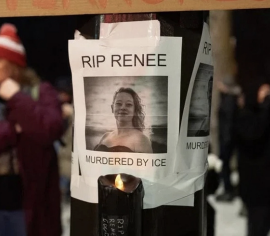
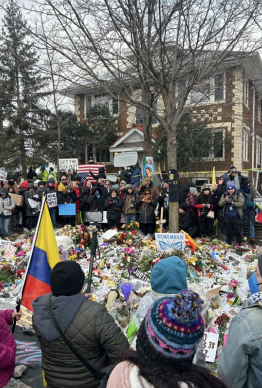
Hours after the death of Renee Nicole Good, thousands of Minneapolis residents gathered in her honor near the site of the shooting. To get a better understanding of the local response, we conducted an email interview with two students who attended the vigil, Matthew Brasser ‘26 and Ben Whittaker-Jolly ‘26.
Q: Could you give us an overview of your experience at the vigil?
Matthew: I remember it being extremely crowded and loud on the outskirts and deeper into the crowd, but when we went right up to the vigil, everyone was quiet, listening to the speakers that organized it. There were a few speakers as people gathered around the vigil setting down flowers or candles or random items. They talked about how the Minneapolis community needs to get together and stand up against tragedies like Renee Good’s killing and help immigrants in the community.
Q: What was the atmosphere like?
Matthew: It was a perfect mix of sadness and anger, with a very strong sense of community, strong enough to genuinely give me chills at moments. Everyone was so incredibly passionate and emotional over Good’s death and the ICE occupation that the whole thing felt emotionally charged, a perfect mix of anger, sadness, and determination.
Ben: There was a lot of anger in the air, with people from the outskirts of the crowd demanding justice and occasionally yelling, but the vast majority were peaceful and mourning.
Q: What inspired you to go?
Matthew: I had been keeping up with the Trump administration since the election season and had seen all the unconstitutional and corrupt wrongdoings of the administration, but when it came into my city and my community, I didn’t want to sit around and watch it happen. I wanted to be on the right side of things and participate in everything I could. Attending the vigil was one way I could get out there for the community.
Q: Were there a lot of other young people there?
Matthew: There were all different ages and races there from retired, to middle age, to probably 15-16. It was mostly younger people surrounding the vigil though. There were quite a few younger people but it was a good mix.
Ben: Outside of the direct circle around the vigil, however, it seemed like the vast majority of the crowd were adults (probably mostly 30-50 year-olds).
Q: What was one thing that stood to you the most?
Matthew: The passion and the exhaustion on every single person’s face. It gave me hope that there were people unafraid to stand up for what’s right, but everybody was also sad that we had gotten to this point in the first place.
Ben: One other thing I’d note was the variety of speakers that they had; we got to hear from Native singers, local representatives, people from the organization that helped set up the protest/were involved with it, and from other community members.
This interview has been edited for clarity and length.
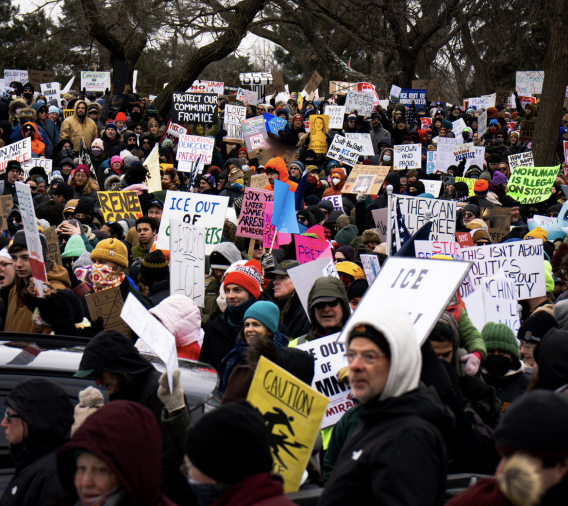
Following the murder of Renee Nicole Good by federal agents on Wednesday, January 7th, many protests were organized in efforts to combat ICE’s presence in Minneapolis. On Saturday, January 10th, tens of thousands of Minnesotans bundled up in 10-degree weather with their neighbors at Powderhorn Park to oppose the actions of ICE in their city.
The protest began with powerful speeches from leaders of key migrant group organizations, such as the Minnesota Immigrant Rights Action Committee (MIRAC) and the Centro de Trabajadores Unidos en la Lucha (CTUL), who spoke about the oppressive nature of the Trump administration and the danger that ICE’s presence in Minnesota has caused. The protest was very communal, with people constantly handing out signs, food, and other supplies to stay warm in the frigid weather. The energy in the park was palpable, with Phoebe Errickson ‘26 commenting that it was “very powerful to see the community come together for a common purpose. The amount of people that were there and the amount of people who were partaking in a peaceful protest to fight for their shared opinions was super powerful.”
Following a few personal anecdotes and chants through the crowd, including calls of “ICE out,” “F*** ICE,” and “C***** la Migra,” a Spanish chant expressing anger toward immigration police, the group began a peaceful march through South Minneapolis, eventually traveling down Portland Avenue past the location of Renee Nicole Good’s murder just three days before. Many people paused at the telephone pole where Good’s car had crashed to pay their respects, placing flowers or their signs down as a sign of remembrance. The protest continued into the late afternoon, with people eventually meeting back at Powderhorn Park before dispersing. Jasper Thompson ‘26 reflects that “For me, [the protest] just gave me a source of courage and hope that other people, you know, are passionate about protecting our neighbors and friends that are in need right now.”
A group of Breck seniors decided to attend the protest together, meeting the night before to make signs. Bianca Breiland ‘26 said that the act of coming together “made the protest feel a lot more comfortable,” especially during what she described as “a very scary time right now.” She added that going as a group helped them feel supported and made it easier to “show up for each other and for the greater Minneapolis community.”
Although the Powderhorn Park protest was only one of hundreds organized that weekend, its size and intentional location drew national attention to the role of peaceful protest in today’s political climate. For many who stood in the cold, marched past the site of Renee Good’s murder, and chanted alongside their neighbors, the demonstration was not just a statement, but a public act of solidarity meant to be both seen and heard by those on the national level.
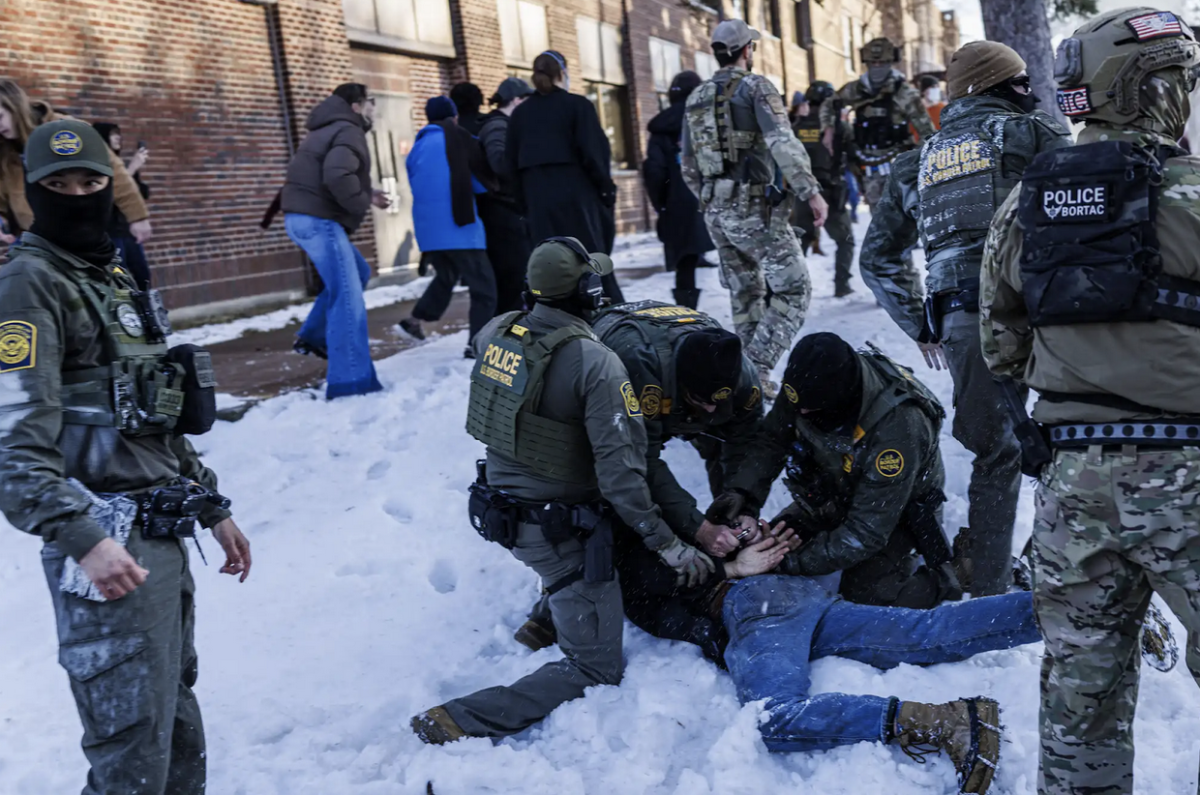
On Wednesday, January 7th, teachers at Roosevelt High School in South Minneapolis were holding a meeting to discuss the effects that the shooting of Renee Good may have on students. It was at that moment that armed US border patrol agents arrived outside the building. According to TIME magazine, the agents were pursuing a woman not affiliated with the school in a car chase when she ended up on school grounds. ICE’s presence on school grounds was technically legal under Trump’s January 2025 revocation of an Obama-era memorandum preventing ICE from conducting enforcement in certain areas, like schools, hospitals, and places of worship. However, it is important to note that under the Fourth Amendment, ICE still needs authorization from school officials or a judicial warrant to enter private spaces like offices, restrooms, and classrooms.
The chase occurred around dismissal time, leaving students, parents, and school staff to be caught up in the chaos. What followed was a violent scene. Agents tackled bystanders, handcuffed school staff, and smashed windows of nearby cars. One school staff member who spoke with MPR News reports being pushed down by an agent; others, including students, were pepper-sprayed, shot with pepper balls, and pulled into ICE vehicles, according to interviews conducted by MPR.
After being made aware of the situation, the school promptly enacted its lockout protocols, with students sheltering in classrooms and others who were already outside running into a nearby public library.
One teacher reported to TIME Magazine that the encounter with ICE “lasted for about 35 minutes. The police had received many calls that this was happening, and they did not come to the school, they did not come to the school anytime. I think local officials…either don’t feel like they have the authority or don’t know what to do when federal law enforcement is in town.”
Following the attack, the Department of Homeland Security (DHS) commented on the situation to KARE 11, stating that “At no point was a school, students, or staff targeted.” This comment seems to contradict the multiple eyewitness accounts and video footage of the operation.
In response to the ICE attacks at Roosevelt, along with the numerous other raids that have occurred throughout the Twin Cities, Minneapolis, and St. Paul public schools are now offering remote online learning through February 12th for all students.
While the original intention of this operation was not to target students or educators, it seems to mark the beginning of what has become a widespread targeting of K-12 students and teachers in the Twin Cities by ICE.
A spokesperson for Saint Paul Public Schools reported to Reuters that two of its contracted student transportation vans were pulled over by ICE, and multiple schools and daycares throughout the metro area have reached out to parents, notifying them of teachers and staff who have been detained.
On Tuesday, January 20th, five-year-old Liam Conejo Ramos, along with his father, was taken into custody by ICE, apprehended in their driveway after Liam arrived home from preschool. When a nearby adult and friend of the family offered to take Liam, ICE agents refused and instead instructed the boy to knock on his front door, “to see if anyone else was home—essentially using a 5-year-old as bait,” according to a statement from Columbia Heights Public Schools. Columbia Heights Public Schools also reported that three other students in their district have been detained by ICE. Two of them, says superintendent Zena Stenvik, were on their way to school.
A 16-year-old girl—under operation PARRIS, a new DHS initiative to re-vet lawfully admitted refugees to root out potential fraud—was also recently detained by ICE. While driving her family’s car, she was pulled over and detained alone. There was no indication that ICE had any belief the high school student was involved in fraud. After being detained, ICE “didn’t have anywhere to put her, and she spent the night in a hotel room with two adult ICE agents who were strangers to her, before, thankfully, the federal court intervened and stopped the US government from sending her to a camp in Texas, which was their intention,” says her attorney and Breck parent Michelle Drake. “This is someone who has done nothing wrong. Nothing. Even if there was a need to investigate some fraud—which there isn’t—since when in the United States of America do we lock people up in order to conduct investigations? That’s not how this country works. That’s not how this country has ever worked,” Drake adds.
Taken together, these incidents suggest a shift in how ICE is operating in the Twin Cities. ICE enforcement is increasingly intersecting with daily student life, and while the DHS maintains that students and schools are not being targeted, ICE’s actions seem to say otherwise. The result has been an immediate disruption to students’ education and sense of safety. As ICE continues to operate in Minnesota, students are moving farther from the periphery of immigration policy and much closer to its center.
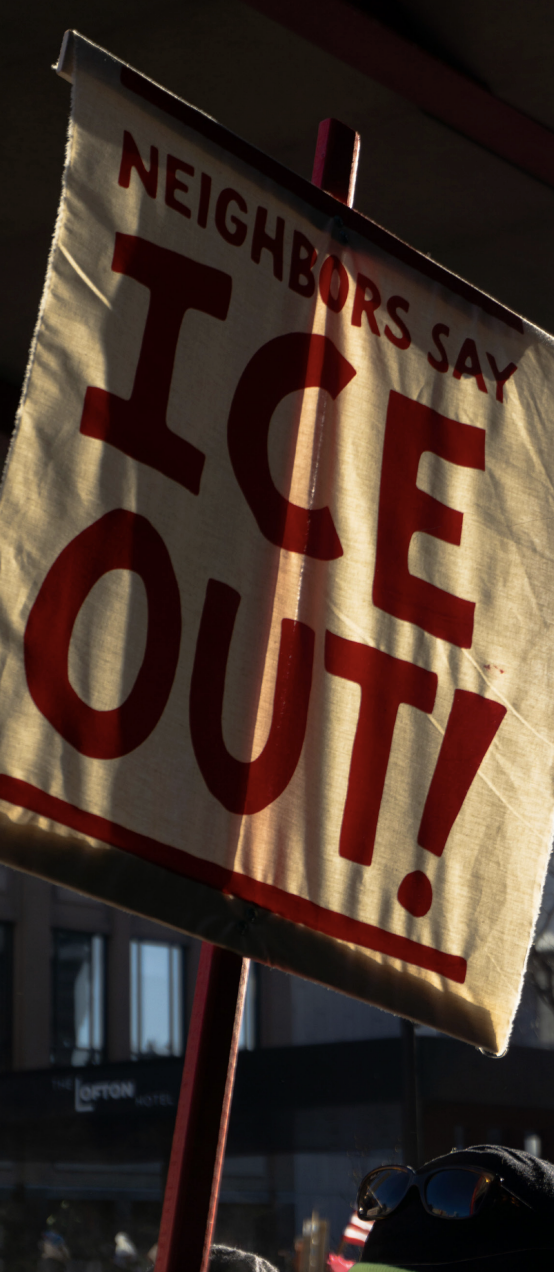
On January 23, Minnesota hosted a statewide economic blackout and protest called Blackout Day. Residents of MN were encouraged to skip work, school, and shopping and instead take to the streets to stand in solidarity against ICE’s actions. The event drew an extraordinary turnout despite freezing temperatures. Organizers reported that around 50,000 people marched through downtown Minneapolis and gathered at the Target Center, making it one of the largest demonstrations the Twin Cities have seen in recent years.
Blackout Day was more than just a rally. It was a general strike and an economic protest. Hundreds of businesses across Minnesota closed their doors in support, and workers from many different business areas and sectors stayed home to join the effort. Clergy and faith leaders from across the country also joined in protesting, with roughly 100 people arrested during a peaceful sit-in at the Minneapolis-Saint Paul International Airport earlier in the day.
The blackout strategy itself is what made the protest stand out. Instead of focusing only on marches and rallies, organizers used economic participation to showcase their scale of dislike towards ICE’s actions. No work, no school, and no shopping sent a clear message that the issue touched daily life for so many people. Businesses that normally would have been open on a busy Friday stayed closed as a visible sign of support.
Minnesota was not alone. Across the country, people joined in. Demonstrators in New York City marched to support Minneapolis, while smaller protests took place in Detroit and other metropolitan areas, even in sub-zero temperatures. These coordinated efforts showcased that January 23 was not just a local event but part of a national movement.
Since then, protests have continued both in Minnesota and across the United States. In Minneapolis, additional demonstrations have kept the momentum of January 23rd ongoing. These protests are a reminder that change takes persistence and that communities can make their voices heard when people stand with one another.
This is not an issue of political ideology. This is an issue of humanity. The United States federal government does not have the prerogative to infringe on the inalienable rights of human beings, regardless of their immigration status. ICE’s operations across the U.S. are not promoting a sense of security and stability—they are stoking fear, spreading white supremacy, and proliferating destruction. Destruction of families. Of communities. Of trust in the government, and its commitment to protecting and respecting the rights of every human body that exists on the land it governs. This is unjust. This is overreach. And this is inhumane.
As an editorial board, we condemn ICE’s actions in Minnesota. We condemn the murder of Renee Good. We condemn the murder of Alex Pretti. We condemn the repeated violations of our constitutional rights. By retaliating violently against peaceful protesters, ICE violates the first amendment. By claiming that Pretti’s murder was justified because of his gun ownership, the Department of Homeland Security violates the second amendment. Minnesota is a concealed carry state and Pretti had the right to carry his weapon on him in public without being shot for it. By entering homes without judicial warrants, ICE continues to violate the fourth amendment. By denying detainees appropriate legal assistance, ICE also violates the fourteenth amendment.
We also condemn the rhetoric used in recent days by the Department of Homeland Security and President Trump when describing Good and Pretti. Calling the victims “domestic terrorists” and blaming state and local officials — like Governor Walz and Mayor Frey — for the murders creates a dangerous narrative that completely misrepresents the truth. This language encourages Americans to ignore the clear-cut video evidence that is right in front of us. Good and Pretti were law-abiding Minnesota citizens, exercising their rights to assemble, observe, speak, and carry a concealed firearm. Governor Walz and Mayor Frey are condemning ICE’s tactics while still working to promote a sense of non-violence, peace, and security on Minnesota’s streets. In this moment of unprecedented, inhumane federal overreach, we can no longer trust our own government’s words. Instead, we urge everyone to trust the evidence of their eyes and ears. The truth is here in the peaceful demonstrations and community vigils in the streets of Minneapolis. The truth is in conversations in the hallways and classrooms of Breck. The truth is captured on videos, and the truth is written into the laws that govern this country. We refuse to ignore or accept anything other than this truth.
It is incredibly easy to feel helpless and terrified at this moment. What is essential to remember is that our voices matter and we can make a difference. The Bugle encourages its readers to engage in their communities, however that may look. Join activist groups, donate, volunteer, organize, protest, call your representatives. Minnesota is becoming the blueprint for resistance. This moment will be researched, it will be written into textbooks, and it will be remembered. It is our duty to our democracy and our duty to our neighbors to uphold the constitution, non-violently demand change, and ultimately get ICE out of Minnesota.


Gretchen Scherer • Feb 24, 2026 at 7:00 pm
Wonderful writing and reporting! So proud of you all!
Jeffrey Broadbent • Feb 5, 2026 at 10:22 am
Thank you so much for your clear and accurate reporting and assessment of the unconstitutional and brutal behavior of ICE in Minneapolis. I also admire your professional level of journalism. You really reveal the truth and its legal implications.