












As it was recently Yom Hashoah—Holocaust Remembrance Day—I am reminded of the semblance of closure provided by the trials and executions of Nazi leadership after World War II. The semblance of closure provided by the trial and execution of Adolf Eichmann—the architect of the Holocaust and Hitler’s right hand man. The semblance of closure provided by the German people’s heartfelt apology to all those who were harmed and killed by the Nazi regime. However, as I think about this closure, I cannot help but ponder the continued lack of closure for those harmed by the Imperial Japanese government.
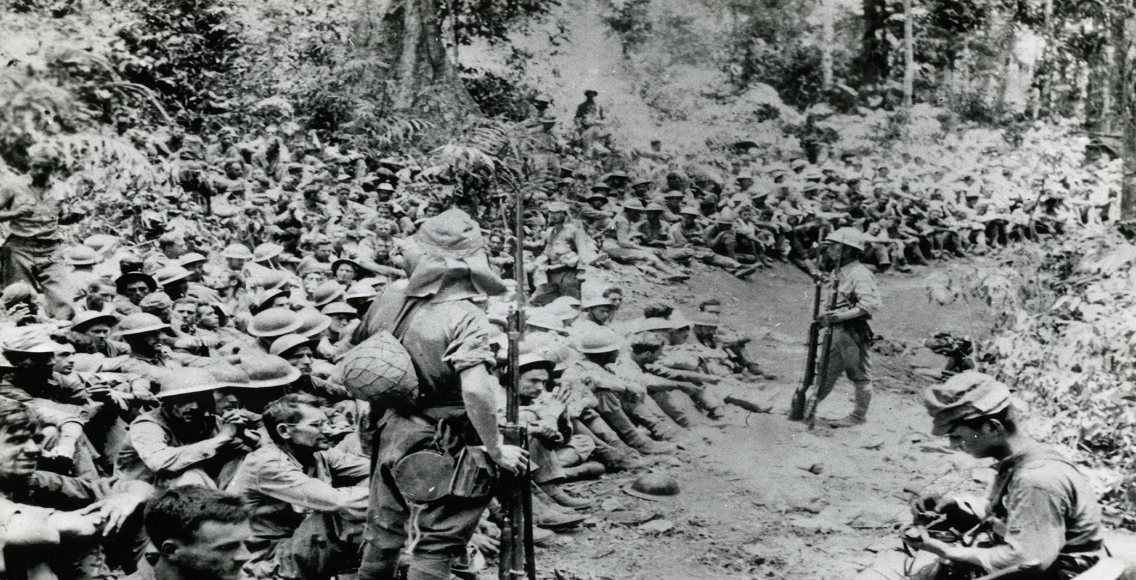
Japan has failed to properly apologize for their misdeeds. For example, in December 1937 through March 1938, at Nanking, China (modern day Nanjing), hundreds of thousands of Chinese prisoners of war (POWs) and civilians were slaughtered en masse. One particularly terrible aspect that I wish to highlight is that many of the women were raped and then bayonetted—where the sword attachment at the end of the gun, known as a bayonette, is slashed into the victim—by Japanese soldiers. Additionally, after the surrender of the Philippines to Japan (1942), tens of thousands of American and Filipino soldiers were forced to march without rest for over 60 miles to a POW camp. Thousands perished on this journey while many others also got sick and died at the camp after arrival. One final example is the Burma-Thailand “Death Railway,” finished in 1943. Japan forced hundreds of thousands of Southeast Asian civilians along with allied POWs (British, Indian, Australian, etc.) to build a bridge for the Japanese government. While building, over 90,000 civilians and 16,000 POWs died. The bridge-railway built with this forced labor connected Burma (modern day Myanmar) and Thailand for the Japanese military. These are only a few examples among an unknown number of atrocities. It is unknown because many of the records were burned and destroyed by the Japanese government, immediately after their surrender, to hide what they did. The extent of the Japanese government apologies have been a quiet “I am sorry” followed by silencing those who try to call further attention to their misdeeds.
In fact, Japan has done the opposite of apologizing, with Japanese leaders visiting the graves of “martyrs” of the Showa (the period during which Emperor Showa, Hirohito, reigned). These “martyrs” are just the Japanese leadership during World War II, meaning these are the deceased who inflicted the harm. For example, they visited the grave of Tojo Hideki, the man who was the Army Minister for the majority of the war as well as Prime Minister before and after Pearl Harbor, which makes him responsible for the military and their actions during World War II. Tojo was, rightfully, executed at the East Asian War Crimes Tribunal (Tokyo Trial) for his abominable crimes.
The Tokyo Trial was a “sister” trial to the Nuremberg Trial. It was set up after World War II by the Allied Powers and the USSR to prosecute Japanese leaders for three crimes: Class A, the crime of offensive war, Class B, conventional war crimes, and Class C, crimes against humanity. Importantly, the Tribunal was more focused on Class A crimes than any of the others (Nuremberg, despite popular opinion, had a similar situation). While the Trial was certainly not infallible—there were two leaders who, in my opinion, were innocent of their crimes and should not have been imprisoned—it did achieve some justice. Unfortunately, some leaders weren’t prosecuted at all for numerous political reasons, including the Emperor of Japan (Hirohito/Showa) at the time the atrocities occurred. This meant not all of the evidence against them was able to be seen. Numerous Japanese leaders, many of whom were partially responsible for the atrocities, were released without even a trial determining their guilt, including the Emperor of Japan during the period. The Tokyo Trial was supposed to have a sequel, but that never occurred—with the trials ending after the first trial. Since there was no sequel, all these former leaders were released, and many found their way back into government; such as Nobosuki Kishi, Minister of Commerce and Industry in Tojo’s wartime cabinet. After his release, he became Prime Minister of Japan from 1957 to 1960. To make matters worse, Shinzo Abe, whose protegé is the current Prime Minister of Japan, was his grandson and Abe greatly revered his grandfather and said his influence was one of the reasons he went into politics.
It is embarrassing that, in the United States, we have no well-known remembrance day for the tens of thousands of US and Allied POWs who were enslaved and killed, despite having the commemoration of Pearl Harbor. It is embarrassing that there is no international remembrance day for the hundreds of thousands of, mostly Korean, women who were forced into sexual slavery by the Imperial Japanese government during World War II often referred to by the euphemistic name: “comfort women” (this phrase is only included for informative purposes; survivors do not like this label, and it is only used in academic contexts). It is embarrassing that there is no international remembrance day for the hundreds of thousands of civilians and surrendering Chinese soldiers killed and raped in Nanking. When cities attempt to commemorate some of the atrocities, particularly the sexual slavery of Korean women, such as with so-called “comfort women statues,” modern Japan protests. For example, when San Francisco put up such a statue, Osaka, their sister city at the time, cut off all ties. In fact, just a few weeks ago Japan’s delegation to New Zealand warned that the construction of a statute (by an NGO) in Auckland could jeopardize diplomatic relations, calling the construction part of an “anti-Japan” movement. I personally can say that before reading a 700 page book on the Tokyo Trial, I had no idea the extent of certain atrocities and for some I did not even know they existed. I had no idea the trials even existed.
When we as a country and the world forget parts of history, we lose a vital source of advice. The Imperial Japanese government came to power in the name of fighting against colonialism and imperialism as a “big brother” to all the other Asian peoples, but quickly became imperialist itself and committed numerous atrocities in the name of that fight. With the rise of political extremism and polarization in our own country, it is vital to remember the dangers of extremism is not confined to one particular set of politics; even fights that are broadly good like anti-colonialism and anti-imperialism are able to be corrupted. We lose the lessons the mistakes made in the Tokyo Trial can teach us. Furthermore, as Americans we have a responsibility to honor our soldiers and our Allies’ soldiers who were murdered because they fought for us and as humans we have a responsibility to honor and commemorate those who have been so terribly wronged. When we ignore the faults in history we can often greatly hurt those who were abused. In my view, we need a single day to commemorate and honor all the victims of atrocities in Asia and the Pacific (American, Korean, Filipino, Australian, Chinese, Thai, Indian, Kiwi, British etc.) during World War II.