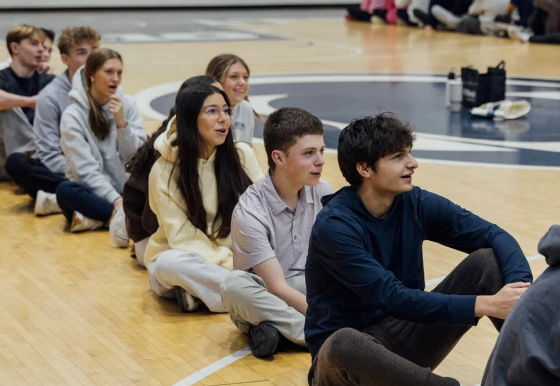

















After hearing Minnesota State Representative Larry Kraft speak about the importance of local climate policy during Environmental Day Chapel 2026, Elsa Eugster ‘27 stayed afterward to ask Representative Kraft a follow-up question about how emerging AI technologies are beginning to affect our state. She listened to his response and reflected on how the effects of AI are already showing up here in the Twin Cities. Shortly after, Elsa headed to her first environmental day session, “Hetch Hetchy and The Birth of Modern Environmental Debate,” taught by Breck’s Innovation Specialist, Mr. Friesen.
Arriving at the session, she was surprised to see that the lesson materials—designed to facilitate a simulation of a historic water conservation debate—were created with the help of generative AI. “It felt really ironic to take advantage of [AI] and use it to waste water while talking about water conservation,” said Elsa.
Mr. Friesen, inspired by a February professional development session dedicated to using AI to make effective classroom simulations, explained that he wanted to find ways to ensure the lesson “wasn’t teacher-centric” and make sure it was focused on “students being able to step into the role of the stakeholders with their own perspectives.” He also noted that the AI helped him fit his activity into a short timeframe of only 40 minutes. “My undergraduate degree is in environmental studies, so I have the background and expertise,” he said. “For this [AI] use case, it was like, how can I design a simulation where students interact from the historical perspective of actual stakeholders to learn about this historical event?”
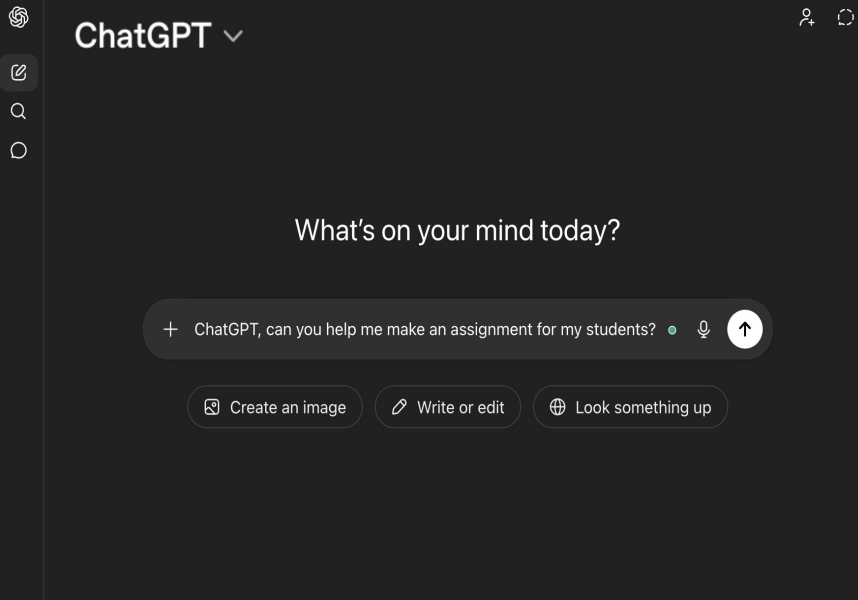
These perspectives reflect the larger question at Breck of how faculty can best integrate AI into the classroom in ways that enhance the Breck experience for both students and teachers. To better understand how AI is being used among faculty at Breck, we interviewed six teachers and administrators (Mr. Barefield, Reverend Bliss, Mr. Birrow, Mr. Colliani, Mr. Friesen, and Mr. Polk). We also surveyed the Upper School student body on their perceptions of how AI is being used by Breck teachers and how that usage impacts them.
When asked to rate their agreement with the statement: “I believe that at least one of my Breck teachers uses AI technology to aid them in their work,” 95.7% of the survey’s respondents indicated that they either agree or strongly agree. According to subsequent data from the survey, some of the most common ways Breck students believe their teachers use AI are to make assignments (75.5%), create study guides (68.1%), and make presentations (51.6%).
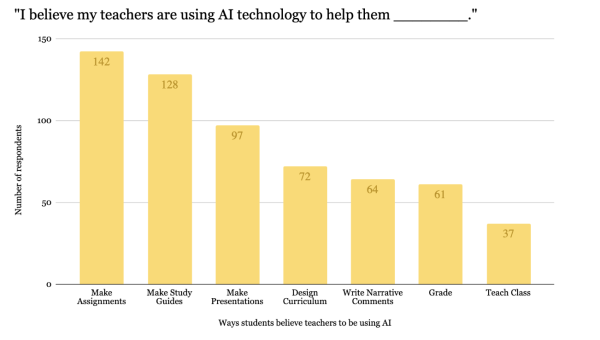
Notes: Respondents were able to select multiple options. A remaining 3.2% of respondents also indicated “I don’t know” when asked this question. A remaining 0.5% of respondents also indicated “None of these ways” when asked this question.
The information we gathered from our interviews with Breck faculty regarding their AI usage was more ambiguous. Mr. Barefield, an Upper School History and French teacher, stated, “I do not use [AI] at all.” He also mentioned that he is “not aware of any faculty using [AI] to create anything.” Mr. Birrow, Breck’s Upper School Music Theory and Music Psychology teacher, explained that he uses AI, but only for help with tedious, mindless tasks, such as writing code or organizing Veracross data, which would otherwise take time away from creative endeavors or grading assignments. Reverend Bliss, Upper School Chaplain and religion teacher, elaborated on how he never received an education degree and sometimes uses AI when it comes to making rubrics. He explained, “I don’t have the training in [teaching]. Honestly, I want to make sure that the rubric is something that’s up to the standards of Breck.” He also explained how AI can be helpful for transforming his notes into ideas for relevant religion or philosophy assignments.
Mr. Polk, a ninth-grade World History teacher and the Dean of Learning and Instruction, explained the recent ways in which AI has become a larger part of the mid-course narrative comment writing process for teachers, noting that AI usage was both allowed and encouraged by the school for support. Mr. Polk highlighted that Breck teachers often have five class sections with 18–20 students each, meaning they are frequently “writing close to 20 single-spaced pages of comments.” He explained that in his previous teaching positions at other institutions, “narrative comments have not been that good. They haven’t been that personalized…They haven’t provided students and families with the kind of information that we most want them to have.” Mr. Polk said that AI, if used correctly, could help teachers save time with comment formatting and sentence structure, allowing them to focus more on the quality of content. After we followed up with Mr. Polk, he revealed that he actually put together a “shared Gemini ‘Gem’ (a customized version of the Gemini AI that acts as a specialist for specific tasks) to assist with faculty narrative comment generation.” Mr. Polk told us that using the Gem “was strictly optional for our faculty” and emphasized that the goal “was to enhance the quality and personalization of our narrative comments.”
Eva Teske ‘26 noted that faculty’s AI use on narrative comments made her “feel like it was rushed and that the teacher didn’t actually take time…I didn’t feel like a priority.” After hearing how exactly faculty were instructed to use AI to help with drafting narrative comments, Eva explained that she felt somewhat better about the process, knowing that teachers were bringing their own insights about students to the AI, rather than relying on the AI to fabricate unfounded information about them.
Even though some training from the Peter Clark Center—including the February professional development day—has tried to outline effective AI use cases, no official guidelines exist for Breck educators. The interviews demonstrated that one of the only concrete, overarching guidelines Breck has given its teachers regarding AI is to prioritize the use of Google’s Gemini, rather than other generative AI tools, because according to Mr. Freisen, Gemini “is covered under [Breck’s] privacy clause…[our] data isn’t being scraped and used to train the LLM or the machine, and we’re keeping our privacy.” When asked if any faculty AI use policy is being developed, Mr. Polk stated that “There’s a question about whether that is something that would be useful…I’d say we’re in early stages on that.”
Many of the administrators who were interviewed emphasized ideal ways AI could be used by teachers at Breck. For instance, Mr. Friesen highlighted how AI “can be used as a productivity and efficiency tool,” and how it can “play a role in the pedagogical aspect, like how am I structuring the lesson? How am I teaching? Is there another way I could do it?” Mr. Polk noted the importance of teachers using AI “with a sense of purpose and intentionality…If we’re using it, do we know why we’re using it and how it is providing something additional…for the student experience?”
Both Mr. Friesen and Mr. Polk also underscored the importance of transparency surrounding teacher AI usage: “I think the guidance is, let’s be as transparent as possible so that we’re finding opportunities to build and maintain trust with our students…knowing that there aren’t hard-and-fast rules to follow here,” said Mr. Polk. Mr. Friesen noted that when teachers use AI, “the important thing is to have transparency and integrity about what you’re using, when and where, and being clear about that.”
However, survey data revealed that student experiences may not always align with administrator’s visions for AI usage at Breck. When asked about how AI usage by teachers impacts respondents’ learning, a majority (56.1%) of respondents reported that teacher AI usage has no substantial positive or negative impact on their learning, while the next largest group (20.6%) said that teacher AI usage negatively impacts their learning. The total distribution of student responses to this question is displayed in the bar graph at the bottom of this page.
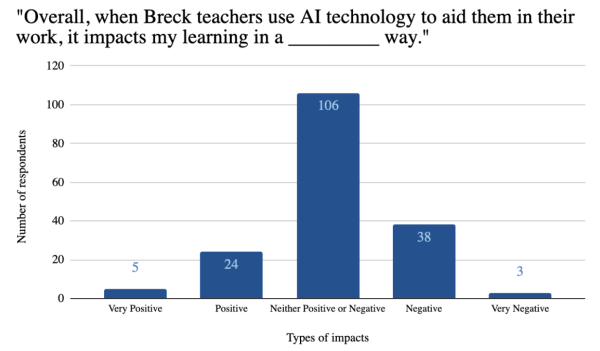
Note: A remaining 6.3% of respondents also indicated “I don’t know” when asked this question.
Data also suggests an issue surrounding a lack of transparency. As stated earlier, 95.7% of survey respondents indicated that they believed at least one of their Breck teachers uses AI to aid them in their work. However, only 83% of the same respondents indicated that a Breck teacher has actually told them they have used AI to aid them in their work. While this discrepancy is not huge, it is important and highlights a possible gap in communication.
Short answer responses from the survey and student interviews suggest that this lack of transparency contributes to some students’ negative experiences with AI in the classroom. One survey respondent recalled a time when a teacher seemingly “copy and pasted an entire assignment straight from ChatGPT…they had the emojis…we could tell [it was AI]…The answer key was on [the assignment].” Another respondent explained how they received “vocab lists where the words are completely irrelevant, and it is just so obvious that AI was used.” Both responses imply that students had to infer whether assignments were made with AI through visible markers, rather than being told directly by teachers. In her follow-up interview, Elsa Eugster echoed these concerns, explaining that her math teacher “uses AI to help us create problems…and he’s really transparent about it as well…but if [AI use] is not transparent, then I think it’s different…I think it’s unfair.”
As Breck continues to navigate the role of AI in our classrooms, the technology’s use remains a work in progress. As Reverend Bliss noted in his interview, “sometimes, there’s a delay between policy, people who are working on policy, and then faculty, and then students.” With no formal guidelines for faculty in place yet, approaches vary from teacher to teacher, and student reactions remain mixed. For now, the school’s use of AI is still taking shape, as both faculty and students adjust to this rapidly changing technology.