

















When I was in first grade, I had a reading tutor. This tutor was not so I could catch up with the rest of my class but rather because I was too advanced. And I would brag about this for years to come. Around this same time, my friends and I would have competitions to see who the teacher considered the “most” advanced when it came to reading. Those A-Z reading levels were no match for us; we were eager to surpass the levels and be able to read at a high school or college level. This love of reading competitions transitioned to a broader love of reading. After school, I could be found curled up with a book on the couch. On Saturdays and Sundays, I could be found in that same position. In elementary school, I mostly enjoyed simple fiction stories—Land of Stories, Percy Jackson, Harry Potter, all the classics. As I matured, middle school me enjoyed intellectual reads—500 page biographies of famous leaders, analysis of historical decisions, the list could go on. And when I entered high school, I never would have imagined that this true joy could dissipate. I was a reader through and through—a product of a scholarly family and community.
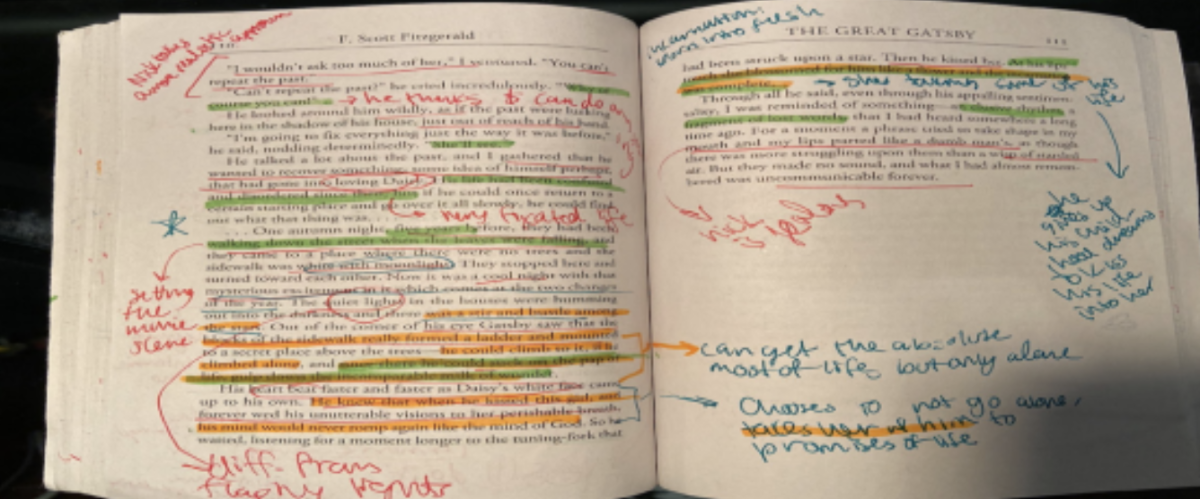
Before high school, I had never really annotated before. They had never been checked. But for my ninth grade English class, I was required to annotate for a grade. As such, every page had a sentence. Every paragraph was filled with underlined and highlighted sentences. I annotated thoroughly. And I received a perfect score for annotations. But I hated that perfect score. I hated the time it took me to annotate. I hated how extraneous these annotations felt. I even hated the book itself. The book represented the world of annotations that I would come to know intimately during my time at Breck. Reading a book required so much effort that I dreaded every reading assignment. With this new understanding of reading, I ceased reading for pleasure. The thought of picking up a book became exhausting. Rather than reading almost a choice book a week as I used to, I barely even read a choice book in two months. All the books I read were a product of English class. And all the books I read required annotations.
In tenth grade, I started avoiding my reading assignments. If annotations were going to be checked, I procrastinated this horrific task until the night before—worsening my hatred of books and annotations. And rarely did I pick up a book for my own pleasure. It was always for school. This continued into eleventh grade. Even in a course as demanding as AP Literature, I looked for shortcuts. Annotations did not help me. They didn’t ensure I understood the material better. They didn’t even ensure that I read the material at all. My best moments were, in fact, when I knew annotations were not going to be checked; I would actually read the book without the fear of tiresome annotations. This year is no different. After four years of torturous annotations, I do not know how to enjoy a book or piece of writing. In conversations with other classmates, I have heard similar grievances expressed (note that I cannot speak for the entire student body). Whatever the reason behind their implementation, annotations simply do not aid my understanding, love, or desire to read. It eliminates any joy I used to have of reading. The girl who used to curl up the couch no longer exists. She was replaced by a busy high school student who avoids books like the plague.
Annotations may be viewed as a guarantee that students read and processed the material, but as a student, annotations are a barrier to reading. My genuine love has become performative. I read for the grade. And perhaps if annotations were more optional, I would annotate on my own. Perhaps I would jot down a thought here and there. I might find myself underlining an especially thought-provoking sentence. But it would be for me. It would be for my love. I would not feel the overwhelming pressure to annotate every line, every page, every detail.