Skip to Content
Categories:

Breck Moves Forward With Exciting Development Plans; Seeks City Approval

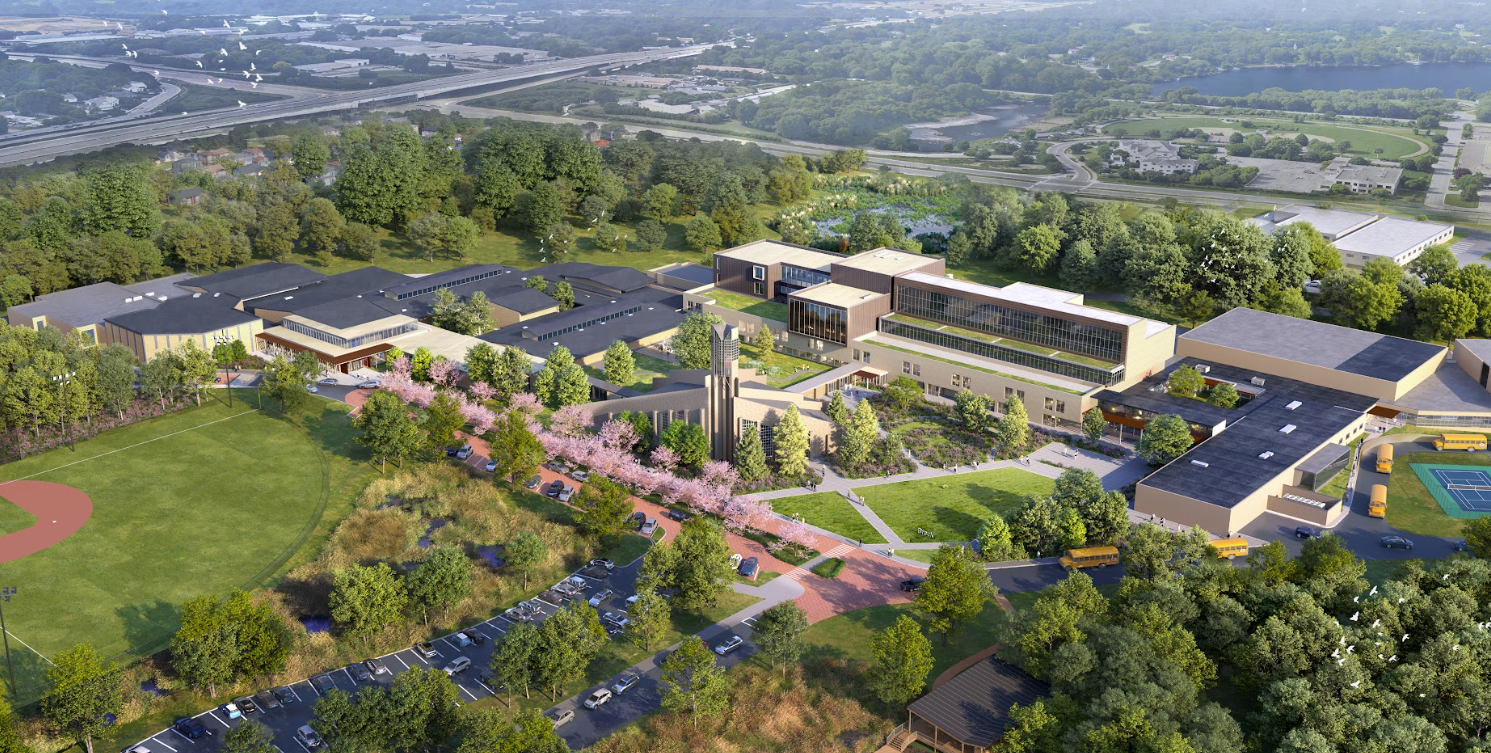
Rendering of redone Breck Campus. Image Credit HGA and Ms. Glaus.
Breck Seeks Approval For New Planned Unit Development


In the past year, Breck made the most significant property purchase in current students’ memory with the acquisition of the Legion. Breck took a significant step in leveraging that purchase into broader changes for Breck’s campus on January 20 by completing a legal process which Breck formally initiated on November 3 to receive preliminary approval for a new Planned Unit Development to govern the use of Breck’s land. A Planned Unit Development is a document issued by the city of Golden Valley which manages the uses and zoning of Breck’s property, and Breck’s current Planned Unit Development states that much of Breck’s property cannot be built on while also limiting the uses of existing buildings. Throughout the process, Breck’s neighbors have heard about Breck’s plans for the property, and have been able to share their concerns with Breck and the city. Changing the Planned Unit Development will allow Breck to begin to implement a new twenty-five year Comprehensive Site Plan, a work that describes the aspirations for future development on Breck’s property.

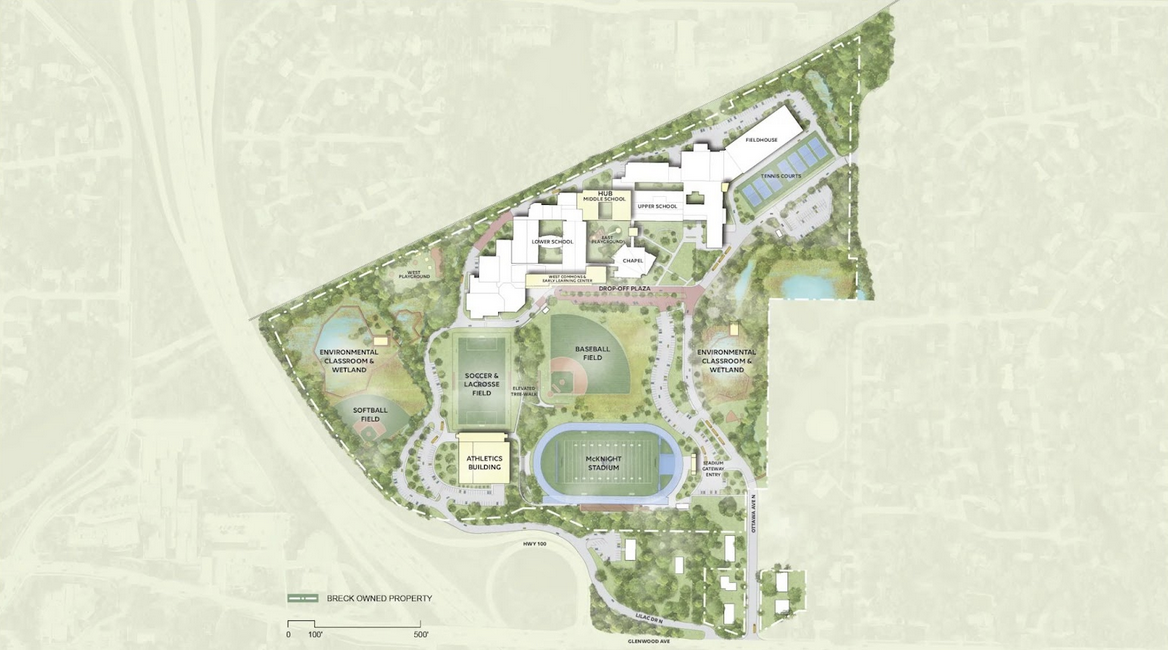
Current draft of the Comprehensive Site Plan. Buildings marked in yellow are planned developments. Image from breckschool.org.
The Comprehensive Site Plan

Breck’s Comprehensive Site Plan is a map representing Breck’s goals for buildings on its property. Ms. Glaus, Breck’s Chief Advancement Officer, described it as a “vision that all non-profit organizations should maintain to help guide future aspirations for their site.” Work on the new Comprehensive Site Plan drew on previous attempts from 2017 and 2011. In 2022, the school solicited faculty input on their vision for a renewed Breck property with faculty workshops and feedback Dr. Hernandez received in her yearly check-ins with each senior advisory incorporated as well. All of these efforts informed Breck’s current plan. 

The two most significant features in Breck’s new Comprehensive Site Plan are two proposed new buildings: an athletics building and a Middle School and Hub. In addition to these two new buildings, the plan also includes smaller renovations and refurbishing of various segments of the school.


Current draft of the Comprehensive Site Plan. Buildings marked in yellow are planned developments. Image from breckschool.org.
The Middle School and Hub

The Middle School and Hub will be four stories, and be in the location of the current preschool and kindergarten hallway. In current designs, the first floor — the Hub — serves as a “thoughtful community space” according to Ms. Glaus. Since the current hallway is traversed by students of all divisions, it would include shared services including an updated Melrose and Peter Clark Center, a future “Center for Well-Being” which would include the school nurse, and a new middle school library and IT space. The next three floors would have new middle school classroom space, increasing classroom capacity in the middle school. 

Since the new Middle School and Hub would overlap with the preschool and kindergarten hallway, the preschoolers and kindergarteners would move to a newly vacant Middle School hallway. A new entrance to the lower school would be built in front of where the current middle school entrance is now. An entrance to the middle school would be created in the chapel hallway adjoining the Breck green, and a new athletics entrance would be created for the fieldhouse and gyms. This would mean that the lower school, middle school, upper school, and athletics would each have their own dedicated entrances to the main building. With the Hub for the Middle School, and the new Lower School entrance, each division would have a space like Salas Commons where students could gather and collaborate. The Comprehensive Site Plan also calls for a renovated theater and performing arts wing, both of which would benefit from a new Lower School entrance, creating a better space for showgoers to enter the building.


The Athletics Building, Field Upgrades, and Utility Improvements

The Hub would be the first priority (of the two buildings) for Breck to build, but Breck also hopes to build a new athletics building. It would have a new pool, and be in the location of the Legion. Pathways would connect the new athletic building to all of the outdoor fields, making the new athletics building the center of all athletics, and making all fields easier to access. The athletics building would also contain concessions, locker rooms, and potentially an additional weight room. Next to the athletics building would be a redesigned Highway 100 parking lot. McKnight would also receive a new entrance on the Mustang Lot side.

The new site plan also includes enhancements to Breck’s land and facilities. Current fields are hard to play in after rain, so the new plan calls for raising the fields and improving drainage so they don’t flood as easily. This would be a welcome change for Breck student Maria Rohlfson ‘26. “Practically, if there is a single drop of rain, the fields are flooded. Other teams’ fields have actually good drainage, and you can play in a drizzle, but with Breck, it’ll become a pond within a day of a drizzle which is not ideal.” 

Raising the fields will shift the field’s locations, and reduce the number of fields by one. Ottawa Field will be turned into a wetland, and a new multipurpose field will be built to replace it in the location of the current baseball field. A new baseball field will be made on the building-facing side of McKnight. Breck hopes to create outdoor classrooms and paths to facilitate outdoor learning, and make sure that the land being converted into wetlands remains usable space. To accommodate the larger footprint of Breck’s buildings and fields, new underground water storage will be built to mitigate flooding during storms. Additionally, Breck will upgrade many of its utilities, such as the boiler, many of which date back to the 1960s. Ms. Glaus described the utility improvements as “maybe the most important of the entire plan, as without heat and water, Breck could not serve students on campus.”

These enhancements to the fields, utilities, and water management will be among the first that Breck makes as part of its Comprehensive Site Plan, as the water management and utilities upgrades must be completed before any other work can move forward. According to Mr. Thorson, some of these early upgrades could start as soon as 2026, assuming Breck is able to receive funding and required regulatory approvals. 

Breck has already hired an architect and civil engineering group called HGA to begin working on concepts for both the physical buildings and the water management solutions. One of the firm’s principal architects, Roxanne Nelson, described HGA’s goal during the design process as attempting to improve the building while maintaining its “mid-century modern feel.”
 

Neighborhood Impact and Traffic Concerns

However, before funds can be raised and HGA and construction can move forward, Breck needs approval for its new Planned Unit Development. Part of the reason that Breck’s previous Planned Unit Development was so restrictive is because much of Breck lies on what is defined as a floodplain by the Federal Emergency Management Agency. This is because Breck sits at one of the lowest points in Golden Valley. Thus, much of Breck’s property is set aside for flood plain mitigation, the reason for many of the ponds, swamps and vegetation across campus, all of which help with drainage. 

For Breck to begin to implement its Comprehensive Site Plan, it first must convince the Golden Valley City Council to amend the Planned Unit Development on its property. A key part of convincing the City Council was showing that Breck had heard community feedback about its plan. A large part of showing Breck’s community engagement was a November 20 meeting in City Hall. 

The November 20 meeting was an official opportunity for Breck’s neighbors to submit feedback to the city as a mandatory part of the City’s process, and came after five additional neighborhood meetings that Breck has hosted of its own initiative since May. Around ten neighbors were in attendance, along with representatives from HGA, the City and Breck. Neighbors raised concerns from maintaining access to the pond for pond hockey in the winter to making sure that Breck was maintaining the properties it owns around the school, but the issue that dominated the conversation about the new plan was traffic.

One neighbor said “I’d like my kids to be able to ride their bikes in the street,” and others referenced a recent traffic study stating that the average speed on Natchez was 29 miles per hour, suggesting a significant number of drivers are exceeding the 30 mile per hour speed limit. Breck proposed a number of solutions to the traffic and speeding including changes to some of the roads surrounding Breck and adding signs with speed limits, however most of these changes will require city approval. Tracey Fussy, a Golden Valley City Councilperson-elect who attended the meeting said that she was “excited for traffic calming measures and sidewalks and partnering [with Breck] to make road improvements.” She also thanked Breck for listening to neighborhood feedback which asked Breck not to use Natchez Park for a new shared softball field between the city and Breck.

One change that Breck committed to making was a redesign of the drop-off area to make it more efficient. Breck hopes that this will reduce some of the traffic build up, but many of the changes to improve speeding outside of Breck requires the city and county’s cooperation — as well as changes in student behavior. 

Following this meeting, a planning commission meeting on December 8 in Golden Valley City Hall approved Breck’s preliminary Planned Unit Development and sent it to Golden Valley City Council for approval. Breck’s focus on neighborhood engagement was noted both at the planning commission and at the broader city council meeting on January 20. Mr. Thorson noted that Fussy, who by January was a full member of the council, specifically noted Breck’s effort to engage with neighbors. Ultimately, the City Council unanimously approved the preliminary updates to the Planned Unit Development.


What’s Next?

Although the preliminary Planned Unit Development has been approved, Breck still requires final approval. Mr. Thorson said the final approval could happen as early as mid-May. Before the final approval is received, Breck must navigate a similar series of meetings with the city and neighbors, while also finalizing details surrounding drainage, stormwater, and utilities. Part of this includes coordination with local and state agencies such as Golden Valley, Hennepin County, Minnesota Department of Transportation, and the Department of Natural Resources, among others. 

 Once the new Planned Unit Development is approved, Breck can begin to raise money and attempt to implement its plans. Ms. Glaus commented that ultimately “it could be thirty years from now, it could be five years from now before any or all of this plan is realized.” 

After the approval of the Planned Unit Development she hopes that Breck will be able to solicit the bulk of additional teacher, student, and parent feedback on plans and designs. She explained that “a lot is yet to be determined,” highlighting instances such as Natchez Park where the plan has been changed in response to feedback from Breck’s neighbors. 

Both Ms. Glaus and Mr. Thorson wanted to make sure to mention the “small army of volunteers and partners” that have helped Breck reach this point, highlighting everyone from civil engineers and land-use attorneys to the company Creative Fundraising Advisors and the mayor’s office.

Mr. Thorson, Breck’s Director of Facilities, highlighted that “just updating the [Planned Unit Development] alone is a huge milestone for our school. That’s a big accomplishment for future generations to be able to act on this Comprehensive Site Plan.” Although many details are still unclear, the preliminary approval of the Planned Unit Development is a milestone that makes real planning and work on the future of Breck possible.

More to Discover