











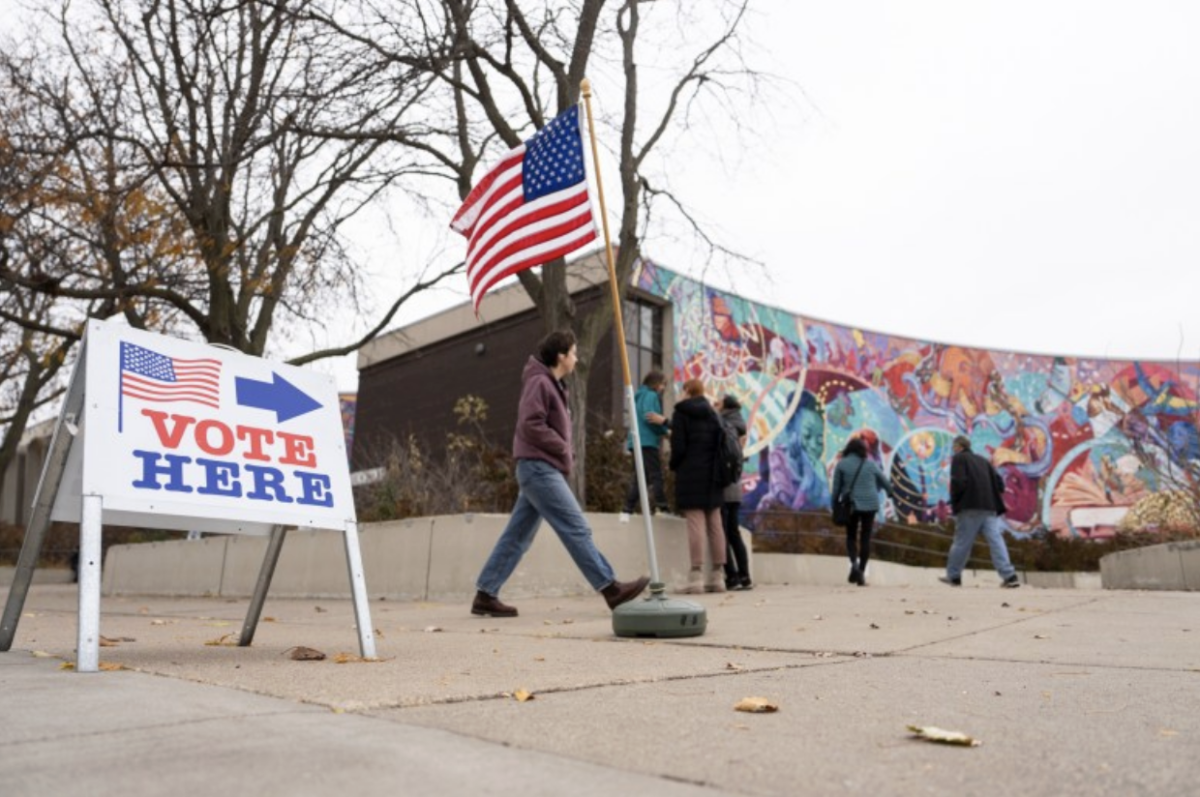
For many, election day can be filled with an overwhelming intensity of emotions. Maybe pride or relief that the candidate you voted for won, or disappointment and anger that they didn’t. Maybe you were confused or didn’t like rank choice voting, or maybe you loved it and felt it more wholly represented your community. Or maybe, you felt none of these emotions, and instead felt completely detached from our democratic process. As an election judge, I watched our most recent election day on Tuesday November 4th from behind the desk, growing an increasing understanding of why civic participation is one of the best opportunities we have offered to us.
Jacob Frey won the Minneapolis mayoral election through a unique system of voting that Minneapolis uses: rank choice voting (RCV). RCV might have felt a bit confusing to new voters as it feels outside of the normal, popular-style vote we are used to. The goal of the system is to make sure the winning candidate has wide support from the public by allowing voters to rank multiple candidates on their ballot. In order to win a race with this electoral system, a candidate must get the majority of the vote, more than 50%. In the first round of tallies, all first choice votes are counted. If a candidate does not have more than 50% of the vote at this time, the candidate with the fewest number of first choice votes is eliminated. The ballots that had the eliminated candidate as their first choice are then recounted and reallocated to their next-highest choice. This process is repeated over and over again until one candidate is left with over 50% of the vote.
Personally, I love the idea of this system. In a two party system, where voters often feel pressured to vote for one of the two top candidates, rank choice voting gives more power to the people to support their preferred candidate whilst still making an impact on the greater election. In the Minneapolis election, I could vote for the candidate I believe reflected my values the best, even if they weren’t necessarily favored among the candidates. Yet, I still could vote for one of the top two candidates as a second or third choice, ensuring that my act of voting for a less-favored candidate as my first choice doesn’t help elect a candidate I dislike. Although the process might seem complex, Fair Vote explains that the majority of voters in Minneapolis, 92%, found that RCV was simple when in the ballot box, and 66% support the continued use of it in future elections. In the Minneapolis mayoral election – with top candidates being Jacob Frey, Omar Fateh, DeWayne Davis and Jazz Hampton – Frey did not win in the first round of voting on the Tuesday of election day. Ultimately, Frey won on Wednesday after a series of eliminations and, according to the City of Minneapolis Voting Page, he accumulated 50.03% of the vote in the last round against Omar Fateh who had 44.37% of the vote. Notably, Frey did not win until the final count, signifying that his victory was made up of Minneapolis citizens second and third choice votes.
November 4th was a day of many firsts for me. Like many of my senior peers, this was the first election that I could vote in. If I’m being honest, it was my first time researching candidates and learning to navigate rank choice voting. Other than Voterama’s mock election last year and my childhood of watching my mom vote each election day, it was my first time seeing an actual ballot and getting to mark down my vote. My voting process was extremely smooth; a two minute ordeal that, thankfully, involved no lines. However, this election I was also able to participate in more ways than just voting; for the first time, I served as a student election judge, learning the ins and outs of how our democratic process operates. Serving in Golden Valley, where the ballot consisted of a single race for two open city council positions, my day was not particularly thrilling, however what it lacked in drama it made up for in small meaningful understandings.
The Minnesota Star Tribune notes that engagement in this 2025 election is especially distinguishable in Minneapolis, which saw record participation with 55% of the city’s registered voters. Working at the polls showed me that the vast array of citizens – each with their own lives, experiences, and perspectives – is what makes up democracy: the first time voters who I helped register and watched as they excitedly grabbed their ballot; the older folk, whose trek to city hall was the farthest they had traveled in a week; the nurses and other workers who had taken their lunch break to vote; the stressed parents carrying five children with them as the checked in; and the young kids eagerly waiting for their parents to cast their ballots so they could grab three stickers. My role was to make the process of voting as smooth and seamless as possible for these people. And surprisingly, this task was fairly easy. The check ins, the voting, and the counting and collecting were all simple but secure processes. More so than I ever would have expected.
Ultimately, serving as an election judge showed me that democracy is not some sort of abstract concept, too confusing for an average student to comprehend. Nor is it something that just happens on its own. Instead, it is a hands-on civic responsibility. Through the work of judges coming in to serve their community, to citizens taking time out of their days to come and vote, democracy is a real-life operation that only functions through the engagement of a wide variety of voices and participation. This experience confirmed to me that the fairness and accuracy of our elections is built through the dedication of people from all walks of life. So, I encourage you to find a way you can make an impact on preserving our democracy through civic engagement.