















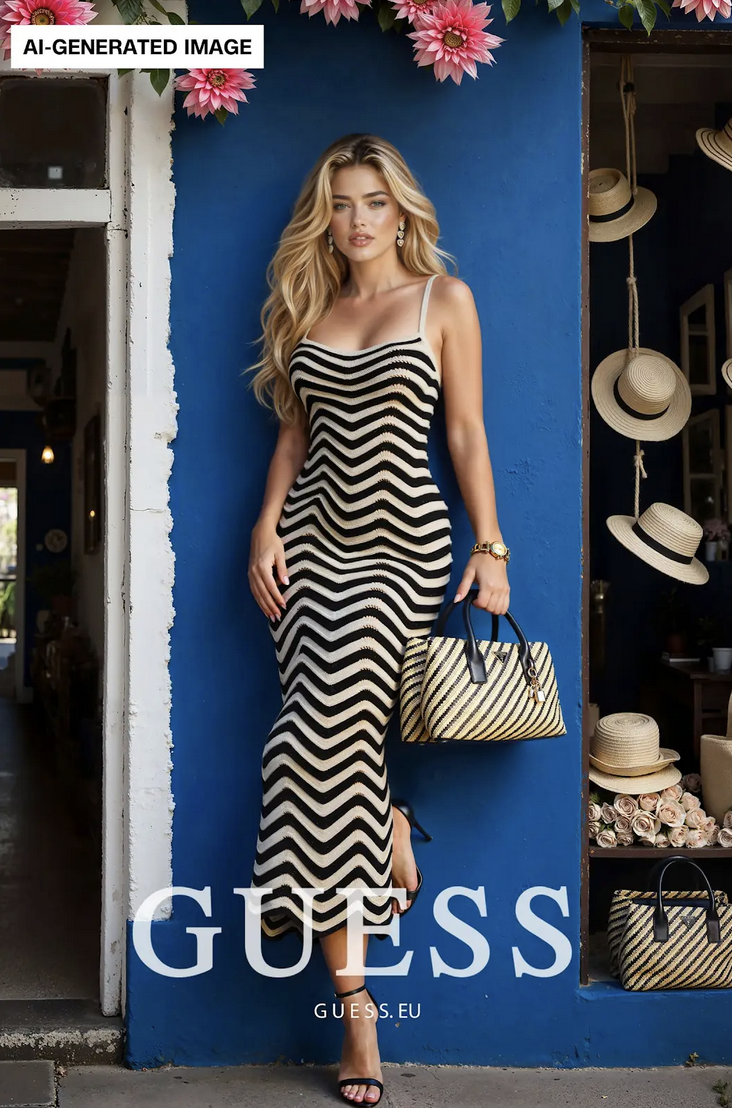
Recently, Vogue sparked global controversy by featuring a Guess ad using AI-generated “models” in the print edition of its August magazine. This was the first time an AI model has been published in the fashion almanac; however, other Vogue publications, such as Vogue Singapore, Italia, and Portugal, have printed AI-generated material in the past, garnering much less worldwide and online attention. It is important to note that these editions are not operated by the same parent company as Vogue and British Vogue, Condé Nast, and are instead licensees with their own management.
The models, named Vivienne and Anastasia, were created by the AI marketing company Seraphinne Vallora, a frontrunner in the new and fast-growing AI modeling and marketing industry. The London-based company was founded in 2023, with a mission “to help luxury, fashion and Real Estate brands tell stories that resonate across cultures, platforms, and time”. In an interview with Good Morning America, they provided some insight into their process of AI model generation. They report that it takes about a month to complete the image after review by the client for exact details and proportions, for which they charge in the low six figures. One of the main benefits of this process, as opposed to traditional modelling, is that this approach requires much less time and money, and provides more choice and customization to the client. However, many are worried not just about the replacement of human models and the decline in job opportunities for them, but also for people in model-adjacent jobs, such as makeup artists, lighting designers, staging specialists, and photographers, as none of these are necessary when using AI. With the click of a button, the prompt can be adjusted to alter an aspect of the generated image.
Another concern that many have voiced is the lack of diversity in the AI models displayed on Seraphinne Vallora’s website and Instagram. All of the models are white and thin, and conform to conventional Western standards of beauty. The company has addressed this, saying that people don’t interact enough with any of the darker-skinned models they have posted in the past, and that, as a business, they do see the importance of improving diversity, but their main goal is to turn a profit. They also said that “the technology is not advanced enough” to create plus-sized models. Many are worried about the possibility of such marketing pushing unrealistic beauty standards, which could be extremely detrimental to the mental health of consumers, especially young women. Now, they are not only routinely forced to compare themselves to supermodels, but to entirely artificial representations of people. Since it is impossible to look like AI, which is designed to look perfect, many are concerned about the probable increase in body image issues due to this technology. The fact that the AI use was disclosed very discreetly in the ad, in a small label in the corner, also raises issues of transparency between the company, the magazine, and readers. In many countries, it is not required that AI use be declared at all. For these reasons, many Vogue readers, especially young people, are canceling their subscriptions, as they increasingly want to see real people represented in media and modeling, rather than AI-generated, or even excessively edited or filtered images. However, AI marketing doesn’t seem to be going anywhere. Many popular brands, such as H&M and Mango, are already integrating this technology into their advertising systems. While it is aiming to provide a more user-friendly experience, with the level of backlash that Vogue and Guess have received, there is no doubt that many customers of these brands would prefer a traditional, human-focused experience.