















What if Breck’s student government had a Constitution—and most students didn’t even know it existed? In 2009, Colton Malkerson (Breck Class of 2009), motivated by the obscurity surrounding the Student Integrity Council, created the Breck Upper School Student Leadership Constitution, outlining the purpose of student government at Breck and breaking down each council’s application process, structure, and responsibilities. This Constitution was designed to be a lasting document, even including an amendment process to allow it to adapt with the school over time.
So, what ever happened to that document, and where is it now? These were the same questions that my fellow council members and I were asking when Mr. Ohm casually mentioned the existence of a Breck Constitution during a meeting in November.
While not detailed in the Breck Student Handbook, student government at Breck currently consists of six councils (see image). Each council covers a different area of student life, working together to uphold the Breck Honor Code and Upper School Mission Statement (both of which can be found in the student handbook). Additionally, a representative from each council sits on the Student Leadership Board, meeting with the Head of School (Dr. Hernández), Upper School Director (Dr. MacDonald), and Dean of Students (Chris Ohm) on a quarterly basis. These meetings are meant to improve communication between the student body and administration and allow for cross-council collaboration.
When I ran for Student Advocacy Council my freshman year, I was oblivious to the extent and the responsibilities of Breck’s student government. At this point, my perception of student council was based primarily on watching Napolean Dynamite (vote for Pedro) and trying (and failing) every year of Lower School to get elected for Lower School Student Council. What I found in my first year on Advocacy Council was not at all what I expected, and throughout my time on the council, I felt I was most productive when carrying out individual or small group initiatives—meeting with faculty one-on-one and approaching students face-to-face to hear their individual concerns. Upon reflection, I found that much of my frustration with Advocacy Council was derived from a lack of structure during our meetings and in the way we approached our various responsibilities. As a sophomore on SDIC, I was faced with similar difficulties when trying to pursue a “passion project,” a concept that many of my fellow council members and I didn’t understand at the time. With these two similar interactions with student government, I found myself questioning the lack of a system to guide new council members and hold councils accountable for doing the work to improve their appropriate sphere.
This past November, when Mr. Ohm mentioned a former Breck Constitution, I was immediately drawn to the idea of updating it. A document that outlined the exact roles of each council and gave student leaders a guiding hand as they took on new responsibilities? It was exactly what I hoped I could provide for future students looking to be a part of Breck’s student government. In the subsequent months, I pestered Mr. Ohm to hunt down the original Constitution; reached out to Colton Malkerson through LinkedIn; spoke with him over Google Meet; decided to conduct my AP U.S. Government Civics Project on amending the Breck Constitution; and sat down to write.
So far, I have worked with Student Advocacy Council to review the original Constitution, rewrite large portions to reflect how Breck student government actually functions today, and draft an updated framework outlining the Advocacy Council. Additionally, I have written a proposal for the creation of a Sustainability Council and shared it with Upper School Administration. Environmental sustainability is an aspect of school life that every community member interacts with on a daily basis, whether they realize it or not, and creating an official council to coordinate student-led efforts and reinforce Breck’s commitment to environmental responsibility would provide institutional support for sustainability initiatives already being pursued. In the coming months, I will be working with representatives from all of the student councils to write the remaining sections of the Constitution, fact-check responsibilities, and make sure the document reflects both student experiences and administrative expectations.
While transparency has long been an issue the Student Advocacy Council has grappled with, significant effort has been made this year into improving communication with the student body. In previous years, the lack of a formal notes-taking system has inhibited the council’s ability to relay information to the student body. This year, the council has implemented an agenda-setting and notes-taking system, recording all meeting notes in a public document linked in the Mustang Minute. Furthermore, any progress on suggestions given to the Student Advocacy Council (either by word-of-mouth or through the anonymous suggestion box linked in the Mustang Minute) is also recorded in the notes document, allowing students to see the status of their suggestions at any time.
Although I will not be returning to Breck next year, I want to leave future members of the Advocacy Council with insight on how they can build a communicative relationship with the Upper School. By switching from a Shared Folder to a Shared Drive (courtesy of Caleb Li), Advocacy Council’s (and all other councils’) files can remain accessible even if an individual leaves (e.g. a student graduates). We hope that this will help facilitate the transfer of knowledge to new members of the student government and give council members a way of tracking progress and looking back on past decisions.
As we continue to make progress, I hope that the creation of a formal Upper School Student Leadership Constitution will give future leaders a helping hand as they step into new positions. I do not want this document to confine student leaders to rigid rules, but rather to be used as a way of setting realistic goals and expectations. Most importantly, I want students to know what they are signing up for before applying to a council, so they can enter student government feeling prepared, confident, and ready to contribute. With continued work and collaboration, I hope to see a new Breck Constitution made public to the student body in spring and officially implemented in the fall of 2026.
Categories:
Reviving the Breck Constitution
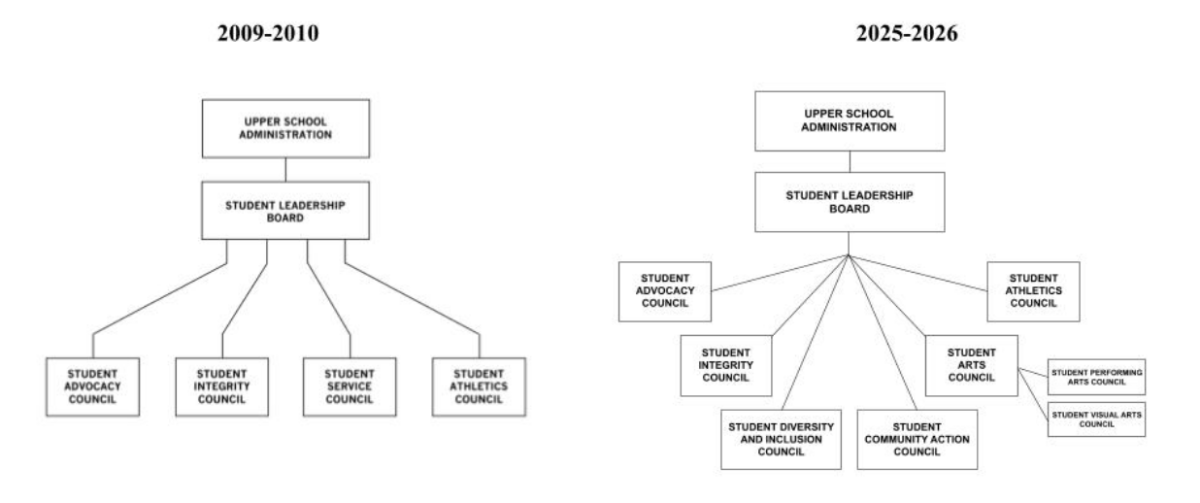
Comparison of Student Government Organizational Chart from 2009-2010 to 2025-2026.
More to Discover
Kristin Markert • Mar 5, 2026 at 4:00 am
Forming of a Sustainability Council is a great idea. Also, thank you for re-organizing the coucil notes and documents to make them useful.