













On February 22, 2026, Nemesio Oseguera Cervantes – commonly referred to as El Mencho – the leader of the Jalisco New Generation Cartel (CJNG) in Mexico, was seriously wounded during a shootout with Mexican government forces and died shortly after while in custody. At least 73 people were reportedly killed during the initial operation and the immediate retaliatory wave. El Mencho’s death and its aftermath epitomize the deep power struggle between cartel groups operating in Mexico and the Mexican government.
Following El Mencho’s death, there was a massive retaliation by the CJNG. More than 250 roadblocks – across 20 states – were constructed, many schools closed, and 25 people in the National Guard died. The Cartel retaliation led to shutdowns in major cities and to suspensions of public transportation.
The Mexican government views the death of El Mencho as a win; however, analysts warn that unless the underlying infrastructure – money, supply chains, and territorial control – of the cartel is dismantled, new leaders will simply rise to take his place. Experts say that the “kingpin strategy” – an approach that aims to dismantle drug trafficking organizations by killing or arresting their top officials – used in this case by the Mexican government will likely prolong the chaotic violence. This chaotic violence is broken into three categories: internal infighting, external predation, and variable factors. Internal infighting suggests that subordinates within the CJNG are expected to fight for control of the organization. External Predation means rival groups, such as the Sinaloa Cartel, may attempt to invade CJNG’s territories due to the vacant leadership. The variables in this violence depend on whether El Mencho had a succession plan and on the strength of the current alliances with other criminal groups.
The current violence in Mexico also symbolizes a larger pattern in the country: a shift from business cartels that fix prices in a boardroom to criminal cartels that use violence, bribery, and territorial control to restrict economic competition and maximize their own profit in illegal markets. Historically, the cartels’ use of transactions was the best way to maximise profit. Groups like the original Guadalajara Cartel focused on the logistics of moving drugs from point A to point B. Currently, groups make more profits by controlling territory. This leads to militarization. A hierarchical military structure and a large payroll for enforcers are required for controlling territory. As of May 2024, cartels are estimated to control roughly one-third of Mexico’s territory. Furthermore, controlling more territory diversifies income. Cartels no longer rely solely on drugs; they now also receive income through extortion, fuel theft, human trafficking, resource extraction, cargo theft, and money laundering.
With the intensified conflicts between different cartels and the Mexican government, new sources of revenue, and advanced weaponry, cartels are continuing to influence Mexico – socially, politically, and economically. As it relates to the recent violence, there has also been backlash against cartels from Mexican citizens, which poses a significant challenge to the administration of President Claudia Sheinbaum, who is also under external pressure to curb cartel-run fentanyl trafficking into the U.S.
The recent death of El Mencho and what followed in Mexico reveal the larger conflict between cartel groups and the government. Given that analysts are skeptical about how successful the “kingpin strategy” of the Mexican government will actually be, the region could risk significant destabilization – where the state loses all control to criminal actors – in the near future.
Categories:
Mexican Government Kills Nation’s Top Drug Lord; What it Reveals About The Country
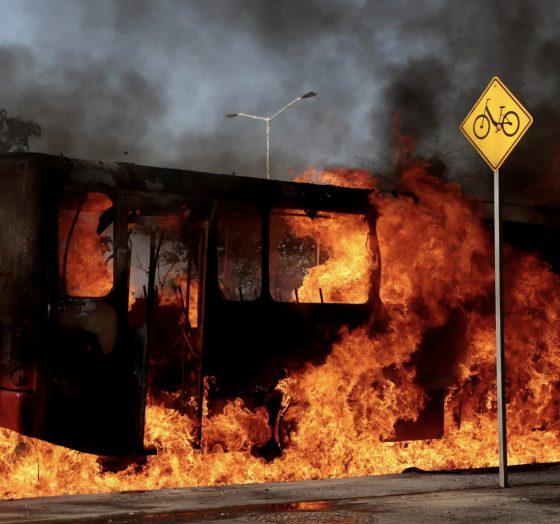
A bus set on fire in Zapopan, Mexico after El Mencho’s death. Image credit New York Times.
More to Discover